Orient yourself in thinking, chart your own path.
Philoscopia places thinkers, schools and fictional characters on the same great questions: 112 profiles so far, with more to come. Each position is grounded in their texts or their deeds. Place yourself in turn: you will see whom you stand close to, and why. Then test your ideas against the objections, all the way to putting them into practice.
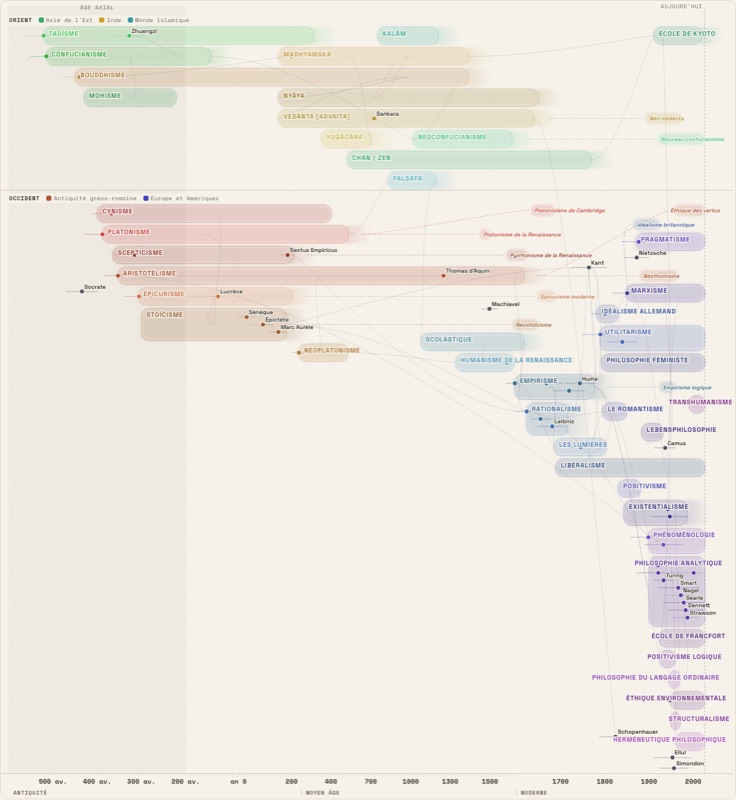
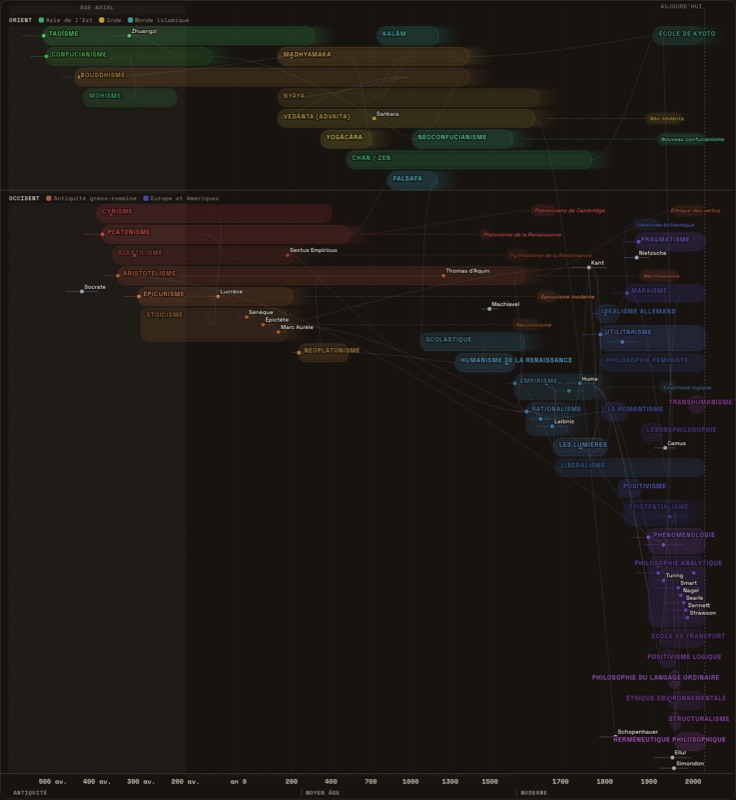 The Atlas of influences →
Confront the great questions
Where do you stand? Put your “YOU” marker where you recognise yourself: each question shows you the nearest thinker, and nothing is saved until you keep your position.
2 questions drawn at random from the 28 essential ones already mapped.All the questions →Explore by theme →
Do we have a nature that precedes us, or do we become what we choose to be?
If a nature precedes us, there is a way to fulfil ourselves or to betray ourselves, but our freedom has limits; if we invent ourselves, everything becomes possible, but nothing guides us and nothing excuses us. To take a position is to say what we owe to what is given to us, and what we alone are answerable for.
Can we reach definitive certainties?
If nothing is ever certain, no knowledge holds firm and action loses its footing; yet to believe oneself certain is to risk shutting one's eyes and learning nothing more. To take a position is to say whether doubt is a form of honesty or a dead end.
Where to start?
- Take a standThe questionnaire, guided journeys (scenarios, objections, thought experiments), or a conversation with Philos, an AI companion designed to make you think, not to think for you.The questionnaire →The journeys →
- Find and articulate what keeps you questioningPhilosophy starts with a problem, not with an opinion. Philos helps you turn what is on your mind into a genuine philosophical question.
- Explore the mapsSchools and lineages, positions on the great questions, a map of the problems: the Atlas gives you the whole landscape of thought at a glance.Open the Atlas →The Atlas of influences →
- Create your profileSet your level and your goals, with or without an account: your data stays on your device.Create my profile →
- Put it into practiceAdopt practices inherited from the tradition and keep your reflections in your notebook.Your notebook →
- Go furtherTalk with the philosophers from their page, connect your note-taking tools, or plug Philoscopia's framework into your AI assistants with the open-source MCP.The figures →Connect your notes →The open-source MCP →
Is Philoscopia useful to you?